
Clean-in-Place (CIP) systems allow manufacturers to reduce cleaning time, labor, water, and chemical use while supporting consistent and repeatable sanitation processes. Working in the food and beverage and pharmaceutical industries, sanitary equipment design and processes are key to long-term success. When processing equipment requires a CIP solution, the Anderson Dahlen team helps specify system requirements and ensure the solution integrates effectively with any existing equipment and facility infrastructure.
Our engineering and manufacturing teams work with you to identify requirements such as flow rates, cleaning circuits, equipment layout, and connection points. We will provide drawings and documentation, fabricate the equipment, support installation, and assist with on-site commissioning to ensure the complete system works together as intended.
A fully integrated CIP system pumps and heats detergents and rinse agents from dedicated storage tanks, recirculating automatically through piping systems, process lines, and mixing vessels. A computer program controls the entire sequence from washing to rinsing. Static spray balls and other spray devices create the turbulent flow and mechanical action needed to clean every interior surface without disassembly.
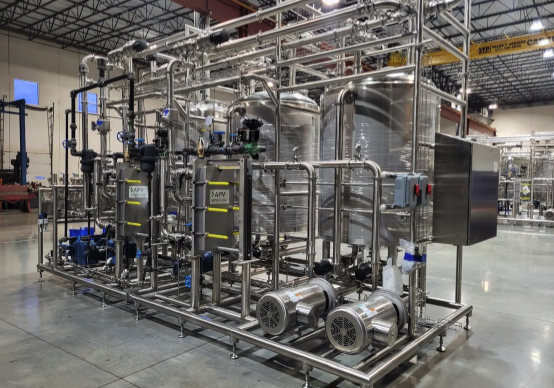
A CIP cleaning system, short for clean-in-place system, automatically cleans the interior of tanks, piping systems, and other process equipment without taking anything apart. Instead of manually cleaning, an automated method circulates cleaning fluid and cleaning agents through closed systems using pumps, spray balls, and spray devices. Because of the thoroughness of the process, many food, beverage, and pharmaceutical production plants rely on CIP systems rather than hand cleaning.
CIP cleans the equipment in place. Storage tanks, process lines, filling machines, and filling lines stay assembled while cleaning solutions circulate through them. COP (Clean-out-of-Place) is for parts that are removed and cleaned separately, typically in a wash tank. Most production lines use a combination of both to reach every interior surface and maintain high process efficiency.
A typical CIP cycle generally includes a pre-rinse to remove loose residue, a wash step with cleaning chemicals at a specific concentration and required temperature, an intermediate rinse, and a final rinse to clear remaining detergent. The exact cleaning procedures are tailored for the product, the cleaning requirements of the facility, and the surfaces being cleaned.
CIP skid systems are widely used across the food and beverage industry, as well as pharmaceutical manufacturing and biopharmaceutical processes. Any production plant handling food, drink, or pharmaceutical products needs a reliable way to prevent contamination and protect product quality between batches.
A CIP skid typically integrates pumps, heat exchangers, storage tanks, spray balls and other spray devices, valves, and piping systems into one state-of-the-art, skidded system. Because it’s pre-engineered and tested as a new system, it drops into your production line with minimal disruption to existing process lines and filling lines.
Yes. A mobile CIP system is built on a portable skid or cart so it can be wheeled between process lines, mixing vessels, and tanks throughout the plant, useful when cleaning needs vary by location. A fixed CIP skid system is permanently tied into a single set of equipment, which typically enables more automated CIP control and a faster cleaning cycle.
Cleaning validation confirms that a CIP process actually removes residue and reduces the risk of bacteria that harbor in hard-to-reach spots. Common methods include swabbing or rinsing tested with a riboflavin solution under UV light (using UV lamps to reveal any missed residue), along with routine checks that interior surfaces and stainless steel components are visibly clean and free of residue buildup after every cycle.